Active AESA Radar
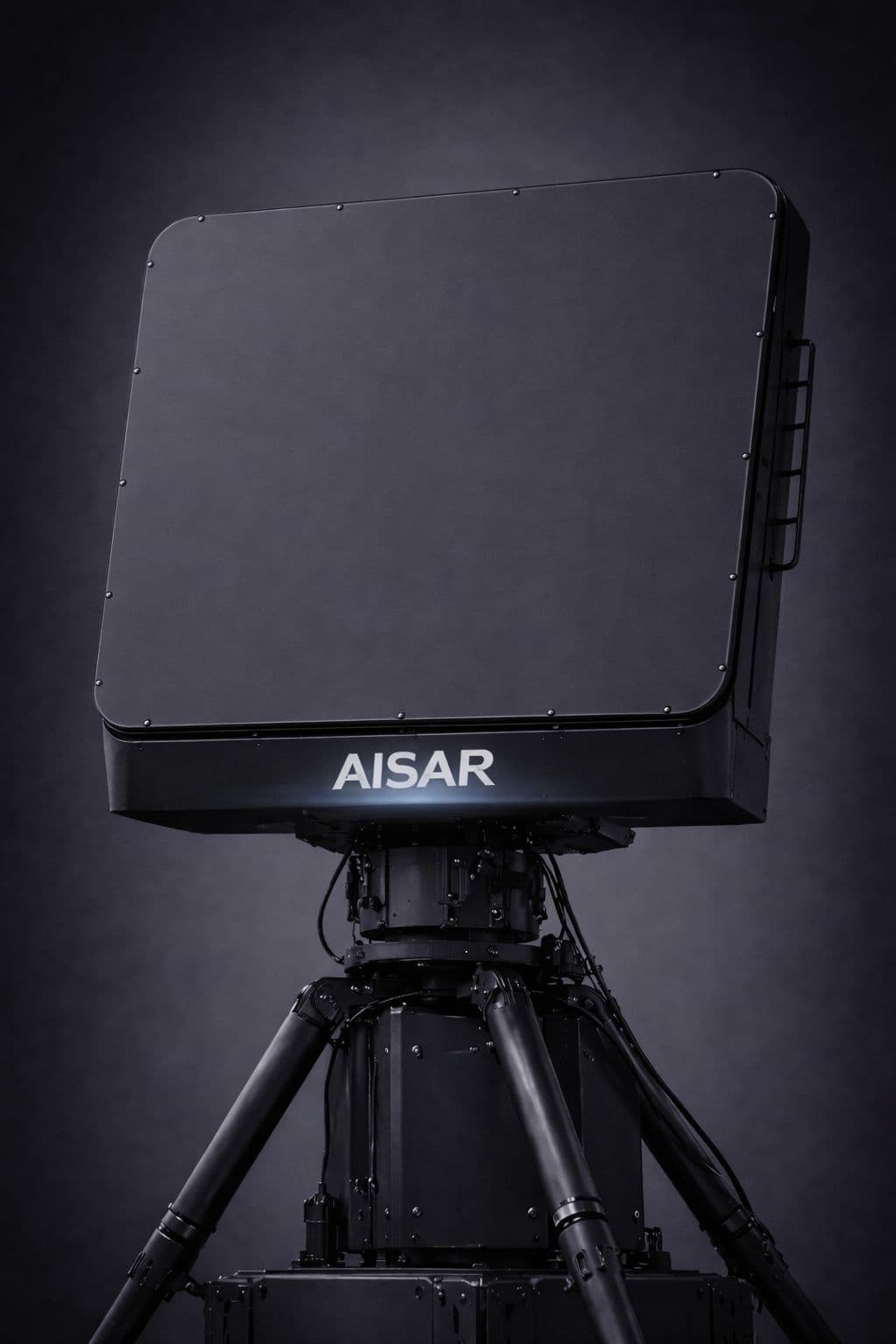
X-band phased array radar with 256–1,024 T/R modules and full digital beamforming. Detects low-RCS drones and Shahed-class threats at 5–12 km. Developed in months, not years, using the AISAR Digital Twin.
TECHNICAL SPECIFICATIONS
Capabilities
256 to 1,024 transmit/receive modules provide electronic beam steering with no moving parts. The beam repositions in microseconds — enabling simultaneous search, track, and discrimination of multiple targets across the full field of regard.
The array geometry, element spacing, and waveform parameters are optimized by the AISAR Digital Twin before a single module is fabricated. This compresses the typical 18–24 month radar development cycle to 6–8 months.
Coherent pulse-Doppler processing provides velocity discrimination down to 0.5 m/s (CPI-dependent). Distinguishes hovering micro-drones from birds and separates multiple cooperating UAVs in formation flight.
Wideband X-band waveforms provide sub-metre range resolution. The system maintains track on targets with radar cross-sections down to 0.01 m² — covering the full range of commercially available consumer and FPV drones.
Adaptive Constant False Alarm Rate (CFAR) processing with ground-clutter maps continuously updated from the current deployment environment. Reduces nuisance alerts in urban and coastal deployments.
Active AESA track outputs feed directly into the AISAR CAPS Fusion Dashboard. Tracks are correlated with passive RF, acoustic, and optical sensors to deliver a confirmed multi-modal threat picture.
Built in the Digital Twin.
Tested before fabrication.
Traditional radar development relies on iterative hardware builds and expensive anechoic chamber campaigns. AISAR replaces this loop with a high-fidelity simulation environment — the AISAR Digital Twin — that models the full electromagnetic behavior of the array, including mutual coupling, near-field effects, and target scattering, at up to 3,360× the speed of full-wave EM solvers.
Array geometry, element tapering, and waveform parameters are optimized using Bayesian surrogate models (R² > 0.98 on validated datasets) — allowing our engineers to evaluate hundreds of design candidates overnight and arrive at hardware with confidence.
Explore the Digital Twin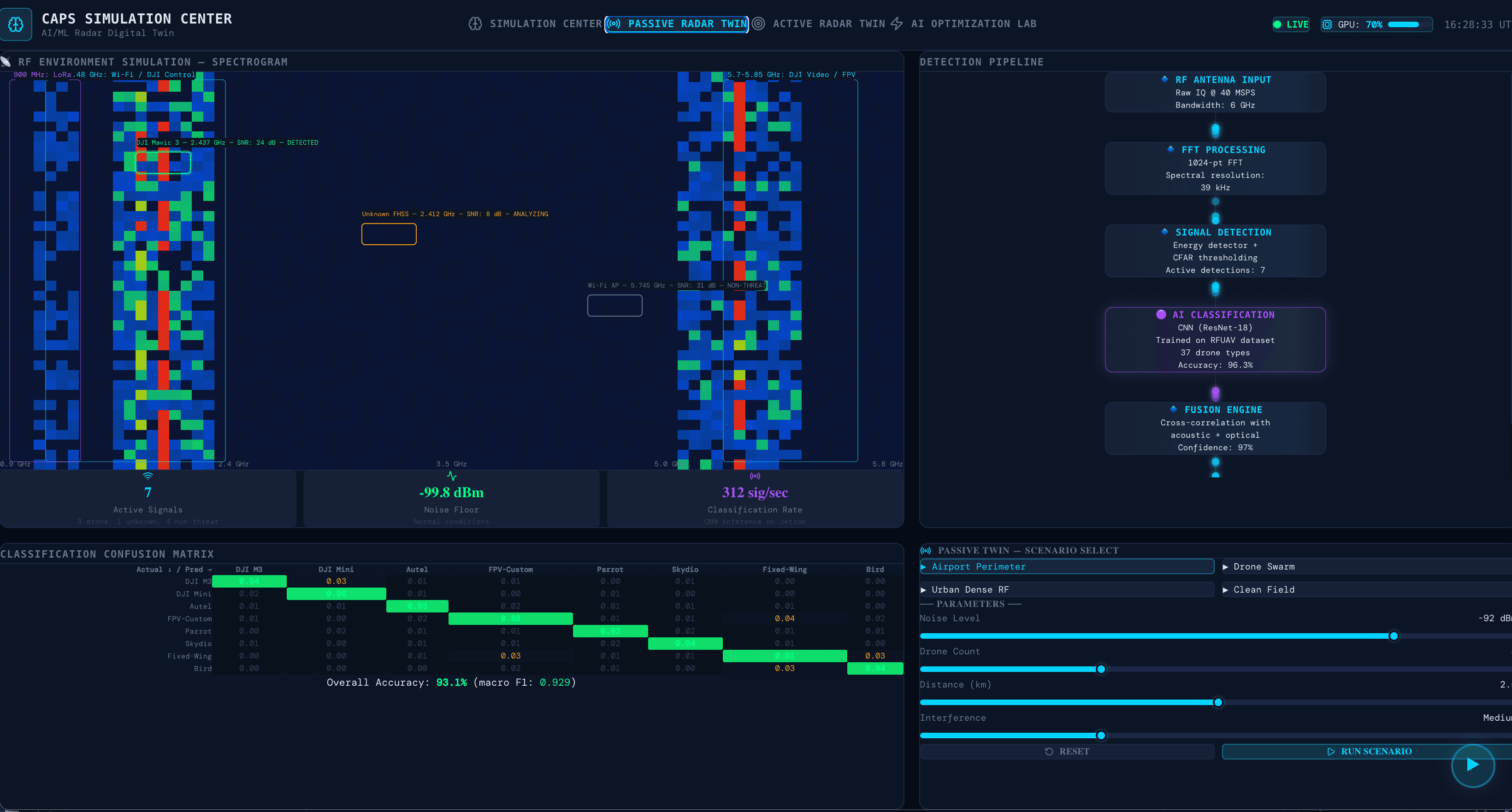
Operational Use Cases
Shahed & One-Way Attack UAVs
Detection and continuous tracking of fixed-wing attack drones (Shahed-136/131 class) at ranges up to 12 km. Provides targeting-quality track data for effector integration.
Airfield & Critical Infrastructure
Persistent 360° surveillance of airports, nuclear sites, LNG terminals, and government compounds. Meets EASA and ENISA counter-UAS detection requirements.
Naval & Coastal Defence
Vehicle-mounted configuration for ship-deck or coastal-battery deployment. Electronic scanning survives shipboard vibration; no moving parts to maintain.
Multi-Domain Integration
NATO STANAG 4586/4607 output enables integration with existing C2 systems, air-defence radars, and electronic warfare platforms.
Interested in the investment track?
AISAR Active AESA Radar is currently in AI-accelerated R&D. We are engaging with defence procurement offices, system integrators, and strategic investors. Contact us for a technical briefing.