The layer that makes four sensors one system.
AISAR Grid is the network and fusion layer. Three to twenty-five or more nodes organise themselves, synchronise to GPS-PPS, correlate across the mesh for meter-class geolocation, and re-route automatically if a node goes offline. Add a node and the network gets more precise, not more complicated.
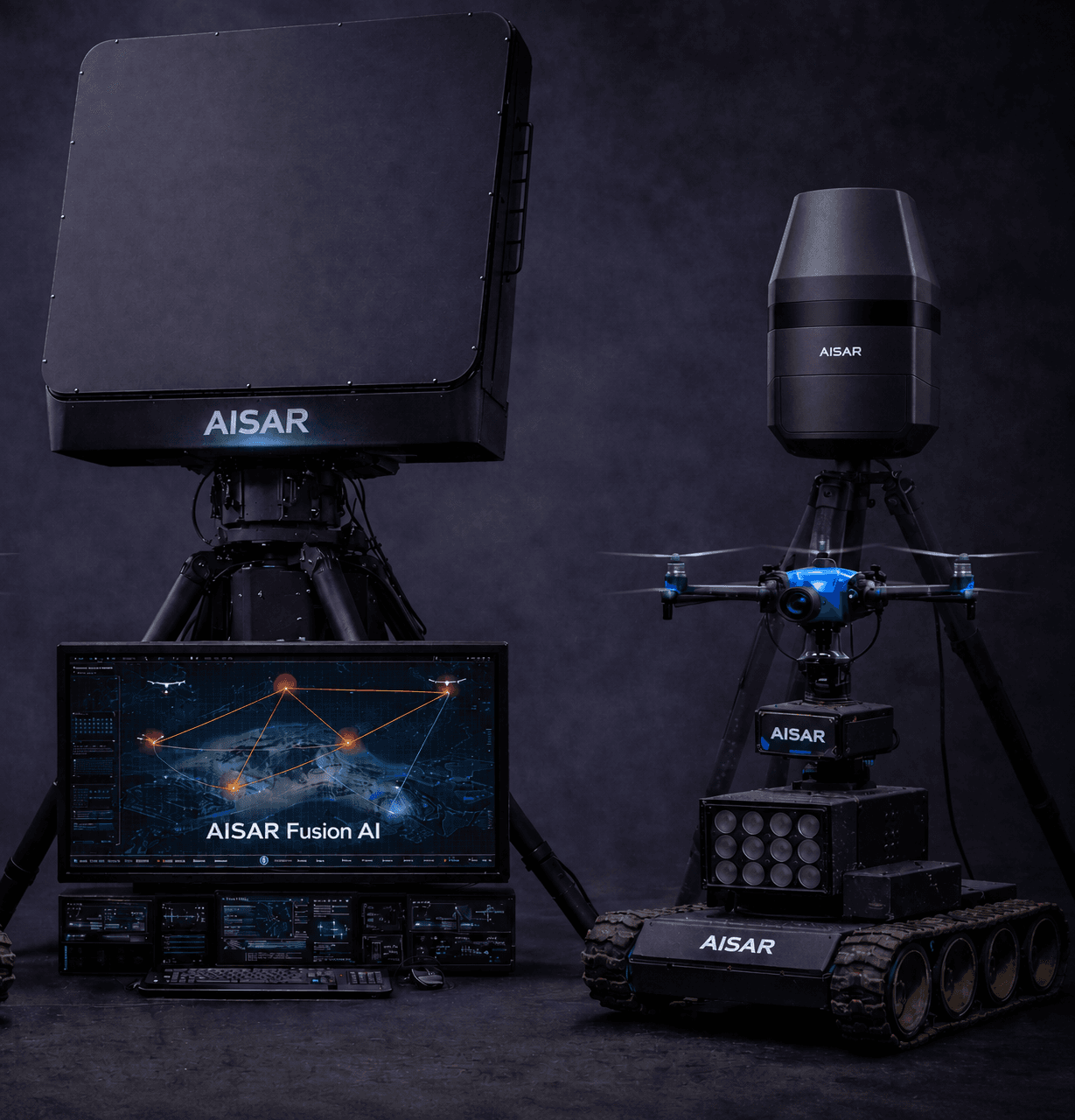
Nodes correlate time and frequency of arrival to place a target in three dimensions to meter class — a coordinate, not a bearing.
No single point of failure and no central node. If one unit goes offline the mesh re-routes automatically and the remaining nodes continue with degraded precision rather than no coverage.
Every node shares a common time reference, which is what makes time-difference geolocation possible across a distributed array.
Cross-node correlation resolves velocity and heading, separates simultaneous emitters, and distinguishes the aircraft from its operator.
Passive RF, short-range, mid-range, long-range, acoustic and optical channels all resolve into a single track. Single-channel false-positive rates of 40–60% resolve to 97% confidence when four channels are fused.
Power on and the mesh discovers itself, synchronises and begins reporting. No configuration file, no site controller, no commissioning engineer.
The mesh publishes tracks to external monitoring and geoinformation systems. It does not task or control external devices.