Built faster than a radar company should be able to build.
Every AISAR sensor is designed, simulated and optimised in software before a single component is ordered. That is how one team covers four bands, and why an improvement to the fusion engine improves every sensor in the line at once.
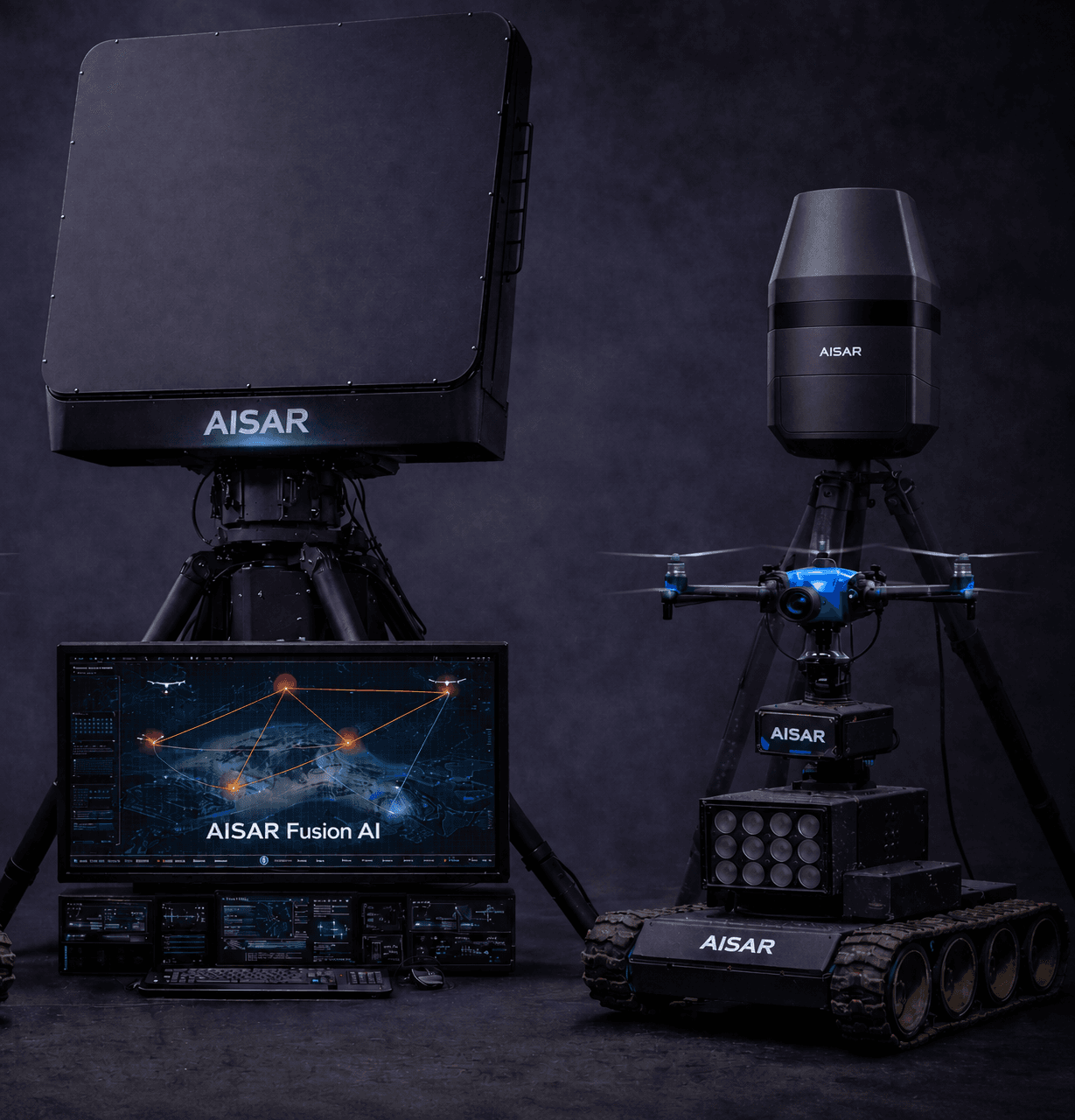
A full digital replica of the antenna array and the signal-processing chain. RF environments, drone signatures, interference patterns and mesh behaviour are modelled entirely in software, at up to 3,360× the speed of full-wave electromagnetic solvers. Thousands of scenarios run overnight, and the virtual chamber replaces most of a physical test campaign.
Bayesian optimisation finds antenna geometry, signal-processing parameters and classification model architectures in 127 evaluations where a conventional parameter sweep needs 10,000. Surrogate model accuracy R² above 0.98.
The same DSP pipeline, tracker, classification models and digital twin run across the whole product line. Only the band, the antenna and the RF front end change. This is why the layers behave as one mesh rather than as four products with an integration project between them.
Classification models are trained on 1.3 TB of real-world operational RF recordings gathered across the full range of interference conditions — not on laboratory captures or synthetic datasets.