The last two hundred metres.
Surveillance radar in this class publishes minimum ranges starting around 150 metres and range accuracy measured in tens of metres. The approach to a transformer, a runway threshold or a terminal roof happens inside that gap. AISAR Close covers it.
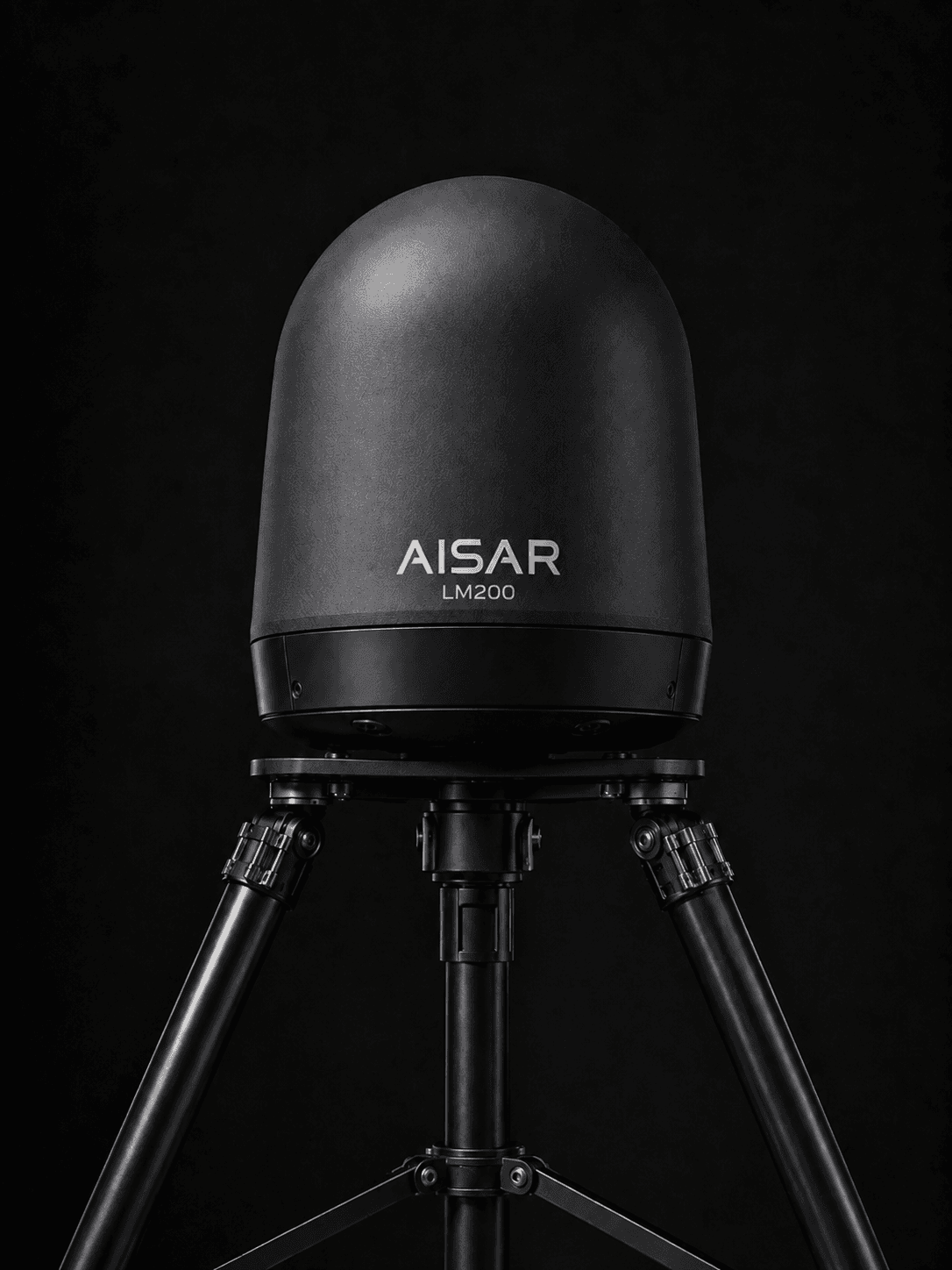
Two reasons, both physical. A small aerial object a hundred metres away sits inside the ground-clutter return of a radar built to resolve a large object at a large distance — the geometry works against it. And a drone flying on a cable or a pre-programmed route emits nothing at all, so an RF sensor has nothing to receive. The close-in zone is not a gap anyone left open by choice. It is a different sensing problem, and it needs a different sensor.
The 76–81 GHz band is the standardised automotive radar allocation in Europe, the United States and China. Around 80% of new ADAS-equipped vehicles are on 77 GHz in 2026, against 45% in 2023. That volume base is why a millimetre-wave sensor with the resolution this job needs costs a fraction of a purpose-built one — and why a site can install several units around a perimeter instead of one expensive post, and keep working if one is lost.
A single sensor on a single mast has a single failure mode and a single line of sight. Several low-cost units around a perimeter see around buildings, cover the dead zones under the main radar, and degrade gracefully. Every unit reports into the same mesh and the same tracker as every other AISAR layer.
Specified and documented as a mobile system from the first design review. In 76–81 GHz it is the application that is regulated, not the frequency; the fixed-installation variant follows a separate authorisation path.
AISAR Close is not a separate product bolted on at the end. It shares the signal-processing pipeline, the tracker, the classification models and the digital twin with every other layer — so a target crossing from mid-range coverage into the close-in zone stays the same track.
Technical specifications depend on configuration, deployment geometry and site conditions, and are confirmed per project.
Spectrum authorisation is separate from export-control classification. Export-control status is determined by the specific configuration, its technical parameters, the country of destination and the end use.
Cover the close-in zone.
Talk to our team about deploying AISAR Close at your site.